Source European Standard Ceramic Plug for Industrial Power, Home Use, Commercial Use
Find 30 listings for the european standard ceramic plug suitable for industrial power, home use, and commercial applications. Buyers can compare specifications, certifications, and pricing from verified suppliers in China.
Key considerations
Products List




Comprehensive Sourcing Guide
Strategic Sourcing Guide for European Standard Ceramic Plugs
Understanding Product Attributes and Technical Specifications
When sourcing a European standard ceramic plug, buyers must first distinguish between the material composition and the functional interface requirements. The supplied product data indicates a diverse range of available configurations, including products labeled with "European Standard" alongside other international variants such as British, American, and German standards. It is critical to understand that while the core keyword specifies "ceramic," the observed product attributes frequently list materials such as "Plastic" and "ABS." This discrepancy suggests that buyers must exercise extreme diligence when verifying the actual material composition of the specific lot they intend to purchase. The presence of "ABS" and general "Plastic" listings in the data implies that many suppliers may offer polymer-based alternatives that mimic the form factor of ceramic plugs but differ significantly in thermal and dielectric properties.
The functional specifications provided reveal a broad spectrum of interface types. While the target is a plug for power applications, the data lists "DC Plug," "AC Plug," and even "RJ45" interface types. This indicates that the term "plug" in the marketplace is often used broadly to describe various connectors. For a European standard power application, the buyer must specifically verify that the product is an AC power plug and not a data or DC connector. The observed current rating of "10A" serves as a potential benchmark, but it is not a universal constant for all listed items. Similarly, the grounding attribute is listed as "Non-Grounding" in some entries, which is a critical safety distinction for European installations where grounding is often mandatory for industrial and commercial safety compliance.
The physical dimensions and standards are equally variable. The data references a wide array of sizes including "British regulatory," "European regulations," "US 2 feet," and "Australian standard." The "European Standard" is explicitly mentioned, but buyers must confirm that the specific plug conforms to the exact pin configuration and voltage rating required for their target market, as the "European Standard" can vary between regions (e.g., Type C vs. Type F). The product origin is listed as China, with specific cities including Fuzhou, Shandong, and Shenzhen, suggesting a concentrated manufacturing hub in the eastern and southern provinces. The "Place Of Origin" is a vital piece of information for logistics and tariff calculations, but it does not guarantee a uniform quality level across all facilities in these regions.
Compliance Verification and Certification Requirements
Navigating the compliance landscape for European standard plugs requires a rigorous verification process, as the supplied data presents a mix of certifications that may or may not apply to the specific ceramic variant. The observed certifications include "CCC" (China Compulsory Certification), "CE," and "RoHS." While "CE" is a mandatory marking for products sold within the European Economic Area, the data also lists "CCC," which is specific to the Chinese market. A buyer sourcing for Europe must ensure that the "CE" certification is valid and supported by a Declaration of Conformity that specifically addresses the European safety directives applicable to power plugs. The presence of "RoHS" (Restriction of Hazardous Substances) is a positive indicator for environmental compliance, but it does not substitute for electrical safety certifications.
The data also references "European Standard" as a product attribute, but it does not specify the exact EN standard number (e.g., EN 60884). Relying on the generic label "European Standard" is insufficient for procurement. Buyers must request the specific standard number and verify that the product has been tested against it. The "Standard" attribute in the data also lists "customizable," which implies that some suppliers may offer non-compliant or proprietary designs. This is a significant risk factor. A "customizable" standard often means the product does not adhere to a recognized international norm, which can lead to rejection by customs or safety inspectors in the destination country.
Furthermore, the "Certification" field in the data includes "CCC," which is a domestic Chinese requirement. While some Chinese manufacturers hold both CCC and CE, the presence of CCC alone does not validate the product for European export. The "CE" listing in the data is a low-confidence background fact in some contexts, meaning it may be self-declared without third-party testing. Therefore, the procurement strategy must include a request for third-party test reports from accredited laboratories. The "RoHS" certification is also listed, which is essential for restricting lead, mercury, and cadmium in the ceramic and metal components. However, the buyer must verify that the "RoHS" claim covers the entire assembly, including the ceramic body and the metal contacts, not just the plastic housing.
Cost Drivers and Pricing Dynamics
The pricing structure for European standard ceramic plugs is influenced by several variables, as indicated by the observed price range of $0.04 to $1000. This extremely wide range suggests that the market includes everything from simple, low-volume components to complex, high-specification assemblies or bulk industrial orders. The lower end of the spectrum likely represents basic, non-ceramic or low-grade ceramic plugs with minimal packaging, while the higher end may include specialized industrial-grade units, custom molds, or orders with specific certification requirements.
Material costs are a primary driver. As noted in the product attributes, "Plastic" and "ABS" are common materials, which are generally less expensive than high-grade ceramics. If a buyer specifically requires a "ceramic" plug, they should anticipate a higher price point due to the raw material costs and the more complex manufacturing process involved in molding and firing ceramic. The "Supply Ability" is listed as "5000 barrels per Month," which is an unusual unit for plugs and may indicate a bulk packaging metric or a data inconsistency. Regardless, this figure suggests that the supplier has significant volume capacity, which can be leveraged for negotiation on unit prices for large orders.
The Minimum Order Quantity (MOQ) is another critical cost factor. The observed MOQ range spans from 1 to 10,000 units. Some suppliers offer an MOQ of "10 PCS," which is ideal for prototyping or small-scale testing. However, for a full production run, the MOQ may jump to 1,000 or 10,000 units. The "Customization" attribute is available, which typically incurs additional tooling costs and higher per-unit pricing. Buyers must balance the need for customization against the cost of the MOQ. If the "Brand" is listed as "OEM" or "houyi," it indicates that the supplier is willing to produce private-label goods, but this often requires meeting a higher volume threshold to be economically viable.
Packaging also impacts the final cost. The data lists various packaging options including "Carton," "Sea Worthy Packing," "Box," and "Wooden Case." "Sea Worthy Carton Packing" and "Wooden Case" are more expensive than standard "Box" packaging but are necessary for international shipping to prevent damage. The "Features" section mentions "Eco-Friendly" and "Stocked," which can influence pricing. Stocked items may be available at a lower price due to immediate availability, while eco-friendly materials might carry a premium. The "Port of dispatch" is listed as "Qingdao," which is a major shipping hub, but the final landed cost will depend on the specific shipping terms (Incoterms) negotiated with the supplier.
Typical Applications and Usage Scenarios
The application scope for European standard plugs is diverse, as evidenced by the product attributes listing "Power Supply," "Industrial," "Home Use," and "Commercial Use." The "Usage" field explicitly mentions "Power plug," confirming the primary function. However, the data also includes "Aquariums" as an item type, which is an unusual application for a standard power plug and suggests that some listings may be misclassified or refer to specialized waterproof connectors. Buyers must carefully match the product's IP rating and voltage specifications to the intended environment.
In industrial settings, the "Industrial Use" application is prominent. The "Current Rating" of 10A and "Advantage" of "High Temperature Resistance" are particularly relevant for industrial machinery and heavy-duty equipment. Industrial environments often require plugs that can withstand higher thermal loads and mechanical stress. The "Non-Grounding" attribute observed in some listings is a critical consideration for industrial applications, as many industrial machines require grounded connections for safety. If the application is for a high-power industrial motor, a non-grounded plug may be insufficient and pose a safety hazard.
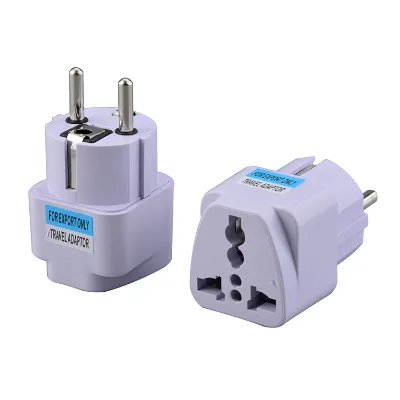
For home and commercial use, the "Color" attribute of "White" is common, but the "Features" section notes that the plugs are "Applicable to multiple countries." This versatility is valuable for commercial buildings that may host international visitors or equipment from various regions. The "Interface Type" of "AC/DC" suggests that some products may be universal adapters, but for a dedicated European standard plug, the interface must be strictly AC. The "Product name" listing "British standard American standard European standard plug" indicates that many suppliers offer multi-standard kits or universal adapters, which may not be suitable for a dedicated European installation without careful verification.
The "Place Of Origin" in China, specifically cities like Fuzhou and Shenzhen, suggests a supply chain that is well-integrated with global manufacturing. The "Port of dispatch" at Qingdao facilitates efficient shipping to Europe and other regions. However, the "Usage" for "Aquariums" highlights the need for buyers to verify the specific application. If the plug is intended for a wet environment like an aquarium, standard ceramic plugs may not be sufficient unless they have specific waterproof ratings not explicitly detailed in the general product attributes.
Supplier Evaluation and Operational Capabilities
Evaluating suppliers for European standard ceramic plugs requires a deep dive into their operational capabilities and reliability. The data indicates that the "Brand" is often "OEM," meaning the supplier is primarily a manufacturer rather than a branded retailer. This is generally a positive sign for buyers seeking custom solutions, as OEMs are accustomed to working with specific client requirements. The "Supply Ability" of "5000 barrels per Month" suggests a high-volume production capacity, but the unit "barrels" is ambiguous for plugs. Buyers should clarify whether this refers to a specific packaging unit or a bulk volume metric to ensure it aligns with their order size.
The "Customization" attribute is a key differentiator. Suppliers offering customization can produce plugs with specific pin configurations, voltage ratings, and material compositions. However, the "Standard" attribute also lists "customizable," which introduces a risk. A supplier who claims to offer a "customizable standard" may be willing to produce non-compliant products. Buyers must ensure that the customization process includes strict adherence to the target European standards. The "Features" of "Eco-Friendly" and "Stocked" indicate that some suppliers maintain inventory, which can reduce lead times. However, the "MOQ" of "10 PCS" suggests that small orders are accepted, which is beneficial for initial sampling.
The "Place Of Origin" in China, with specific mentions of Fuzhou, Shandong, and Shenzhen, indicates a geographically concentrated supply chain. While this can lead to competitive pricing, it also means that buyers should verify the specific factory location to ensure it meets their ethical and quality standards. The "Port of dispatch" at Qingdao is a major logistics hub, which is advantageous for shipping. However, the "Lead Time" is not explicitly provided in the data, so buyers must negotiate this term carefully. The "Product name" listing multiple standards suggests that the supplier may be a generalist, which could be a risk if they lack deep expertise in European standards.
Quality Control and Long-Term Procurement Considerations
Ensuring consistent quality for European standard ceramic plugs requires a robust quality control (QC) framework. The observed "Certification" of "CE" and "RoHS" provides a baseline, but buyers must implement their own QC protocols. The "Material" attribute lists "Plastic" and "ABS" alongside the target "ceramic," so incoming quality inspections must verify the actual material composition. The "Current Rating" of 10A and "High Temperature Resistance" are critical performance metrics that must be validated through testing. Buyers should request sample testing reports that verify the plug can handle the rated current without overheating or degrading.
The "Packing" attributes, including "Carton," "Sea Worthy Packing," and "Wooden Case," are essential for protecting the product during transit. "Sea Worthy Carton Packing" is a specific requirement for international shipping, and buyers must ensure that the packaging meets the necessary standards to prevent damage. The "Color" of "White" is a standard aesthetic, but buyers should verify that the color is consistent across batches to maintain brand uniformity. The "Interface Type" of "AC/DC" and "RJ45" in the data highlights the need for precise inspection to ensure the correct interface is delivered.
Long-term procurement considerations include the stability of the supply chain and the ability to scale. The "Supply Ability" of "5000 barrels per Month" suggests scalability, but the ambiguity of the unit requires clarification. The "Customization" capability allows for future product evolution, but buyers must ensure that the supplier can maintain consistency over time. The "Standard" of "European Standard" is a fixed requirement, and any deviation must be addressed immediately. The "Location" of the supplier in China, specifically Fuzhou, Shandong, and Shenzhen, offers access to a mature manufacturing ecosystem, but buyers should conduct regular factory audits to ensure compliance with labor and environmental standards.
| Attribute | Observed Data Point | Verification Requirement |
|---|---|---|
| Material | Plastic, ABS, Ceramic | Confirm actual ceramic composition via sample testing |
| Certification | CCC, CE, RoHS | Verify valid CE Declaration of Conformity for Europe |
| Current Rating | 10A | Test for thermal stability at rated load |
| Grounding | Non-Grounding | Confirm grounding requirements for specific application |
| Origin | China (Fuzhou, Shandong, Shenzhen) | Audit factory location for quality and compliance |
| Packaging | Carton, Sea Worthy, Wooden Case | Ensure packaging meets international shipping standards |
| Standard | European, British, American, etc. | Verify specific EN standard number and pin configuration |
Final Procurement Strategy and Risk Mitigation
The final step in the procurement process involves synthesizing all gathered information into a coherent strategy. Buyers must prioritize suppliers who can demonstrate a clear understanding of European standards and provide verifiable documentation. The "Customization" feature is a double-edged sword; while it offers flexibility, it also introduces the risk of non-compliance. Therefore, buyers should insist on a "Standard" that is fixed and recognized, rather than a "customizable" one. The "MOQ" of "10 PCS" allows for low-risk sampling, which is essential before committing to larger orders.
The "Price Range" of $0.04 to $1000 underscores the importance of defining the exact product requirements. A low price may indicate a non-ceramic or non-compliant product, while a high price may reflect specialized features or bulk packaging. Buyers should aim for a price that reflects the quality and compliance of the product, rather than simply the lowest cost. The "Supply Ability" and "Port of dispatch" at Qingdao are positive indicators of logistical capability, but buyers must confirm the actual lead times and shipping costs.
Ultimately, the success of the procurement depends on rigorous verification and clear communication. The "Features" of "Eco-Friendly" and "Stocked" are beneficial, but they should not overshadow the primary requirement of safety and compliance. By focusing on the "European Standard" and verifying the "Material," "Certification," and "Current Rating," buyers can mitigate risks and ensure a successful sourcing outcome. The "Place Of Origin" in China is a common source for such products, but the specific factory and its quality control processes are the true determinants of success.
FAQs
What certifications are available for European standard ceramic plugs?
Available certifications include CCC, CE, and RoHS for these products. Buyers must verify that CE marks are supported by valid Declarations of Conformity for European safety directives, as CCC is specific to the Chinese market and does not automatically validate the product for export.
Which materials are used for European standard ceramic plugs?
Products are listed with materials such as Plastic and ABS, though the core keyword specifies ceramic. Buyers must exercise extreme diligence to verify the actual material composition, as many listings may offer polymer-based alternatives that differ significantly in thermal and dielectric properties from true ceramic.
Can I find European standard plugs with a 10A current rating?
Yes, a 10A current rating is observed in the product data for these plugs. However, this is not a universal constant for all listed items, and buyers must specifically confirm the current rating matches their application requirements, especially for industrial or heavy-duty usage scenarios.
How does customization affect the minimum order quantity?
Customization is available but typically requires meeting higher volume thresholds to be economically viable. While some suppliers offer an MOQ of 10 PCS for standard items, custom molds and private-label branding often increase the minimum order quantity significantly.
Where are European standard ceramic plug manufacturers located?
Manufacturers are located in China, with specific origins including Fuzhou, Shandong, and Shenzhen. These cities represent concentrated manufacturing hubs in the eastern and southern provinces, which influences logistics and tariff calculations for international buyers.
What packaging options are available for shipping these plugs?
Packaging options include Carton, Sea Worthy Packing, Box, and Wooden Case. Sea Worthy Carton Packing and Wooden Case are more expensive but necessary for international shipping to prevent damage, whereas standard Box packaging is less costly but offers less protection.